Wednesday, November 25, 2009

You Have no Rights, Play Nice - 11-25-09

As many music lovers know, Digital Rights Management, DRM for short, is the term for the piracy protection inserted in many music files purchased through a download store such as Zune Marketplace or iTunes.
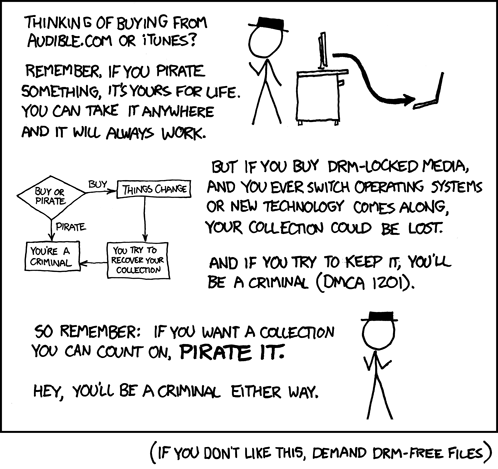


DRM is broken idea created by an organization that still has no idea how the internet works and is terrified by it. Much like other anti-piracy measures, music DRM does little to stop piracy but does much to hinder the experience of legitimate owners. DRM can be broken, but the users who fall under bad luck who don’t know how to circumvent it because they don’t want to be pirates, lose access all of their files. However, most stores allow customers to re-download a song a set number of times (usually between 3 and 5) before they have to call customer support to get more downloads. What’s truly unfortunate is that DRM is based around the concept about digital media that consumers purchase a license to use it, as opposed to something they own and can do whatever they want with. This hurts consumers who are used to the idea of purchasing something and owning it. The best piracy prevention I have experienced is a music store that is easy to access. If I can buy a song easily, I have no reason to steal.

Most digital music stores provide DRM-Free MP3 versions of most, if not all, of their songs. The risk here is that if something happens to the mp3 file, the consumer is completely out of luck. Mp3s are not eligible for re-downloading and, in some cases, are not capable of being re-purchased. It recreates the ownership life, with the possibility of losing everything with a disaster. However, unlike most property, your files are much more fragile, capable of being destroyed by a bad-timed power outage.

From Sensory Overload to Gadget Glory - 11-25-09

Engadget.com got a redesign last week. It’s pretty amazing how it changes the impression of what Engadget is. It looks like a site for gadget news and features as opposed to a gadget blog.


When I first saw it, all the colors and text put me into a pseudo-coma from all the information being pounded into my brain. After that subsided, I was quite impressed with the presentation. All of the stories deemed important by the Engadget staff at the very top of the page before the user can see any other news posts. It gives the feeling of a company that really cares about how they look so that when someone links to them, the user following the link sees that the website is reputable and professional. Blogs have a negative connotation, especially for people who do not follow blogs on a regular basis as their news source, so making a blog site look different than a typical blog is a great design choice.

In my week of using it, I only have one issue with the site. With all of the top-of-page featured content, my 1280x1024 resolution monitor does not see any brand new news content without scrolling. I only have to scroll slightly, but I feel that dedicating that much real-estate to content that may not be the “hottest new thing” does not seem like the best idea.

Hot Recorder, Not-so-Hot Website - 11-25-09

I was looking around the internet last week or so, looking for the tools I would likely need to be able to podcast, specifically Skype-based podcasts. I was directed to the site for HotRecorder, a program that would allow me to use Skype to record multiple participants easily. However, I could not stay at the site long enough to look further into the product as the design repulsed me.


The only explanation I could determine for myself is that it was designed for touchscreen smartphones like the iPhone or Droid. To test its mobile-centric design, I fired up my BlackBerry’s Opera browser and loaded it up. I assure you, it was either designed specifically for the iPhone or for an audicence that does not exist in this world. A horizontally based website is unique, to see the least, but it’s not feasible. It’s not Flash-based, so they couldn’t incorporate a navigation tool that acts like the Hand in Photoshop and Illustrator, and none of my mice have the ability to scroll left and right.

Also, their background design flickers when I scroll, making the page all the more painful to use. A preliminary google search for the designer page brings up no results. I had never seen a horizontal site before, so I googled that instead, and found the perfect example of how to operate one. The Horizontal Way uses mouse-touch sensitive buttons for smooth navigation across the layout. It also advocates the use of Horizontal Pages as a way to better take advantage of the real estate provided by computer monitors, mentioning how “Another value of the horizontal site is that it can utilize almost all the space offered by the browser’s viewport.”

We’ll Stick Together as We’re Writing a Blog Post - 11-25-09

Tripping Down the Freeway is a new song from Weezer on their new album, Raditude. A cheery melody with lyrics that could be interpreted in multiple ways, it’s my favorite song on the album.


I listen to most of my music while driving or walking, and this song’s rhythm has a great sense of motion. In my mind, I can see the lines of the road or cracks in the sidewalk passing by as the song progressing. My favorite part is what I consider to be the climax of the song where only the vocals and guitar are heard, which gives me the sensation of being on a long curve where the “g’s” of the turn are pushing you into the car a bit.


I was interested to see if anyone else on this wonderful series of tubes, better known as the Internet, shared similar feelings in regards to driving songs and motion. One of the first results I found on google was a list on DormDelicious.com. Number 21 was song I enjoyed, Shipping up to Boston by the Dropkick Murphys. I wanted to listen to it again, so I found the Youtube video of their music video. Imagine my surprise when the beginning of the song, and all of the “action” later, is based around motion: trains, car rides, foot chases, the whole nine yards. There has to be something to this idea of a driving song conveying the idea of motion if a director is going to show various acts of movement to accompany a song like that.